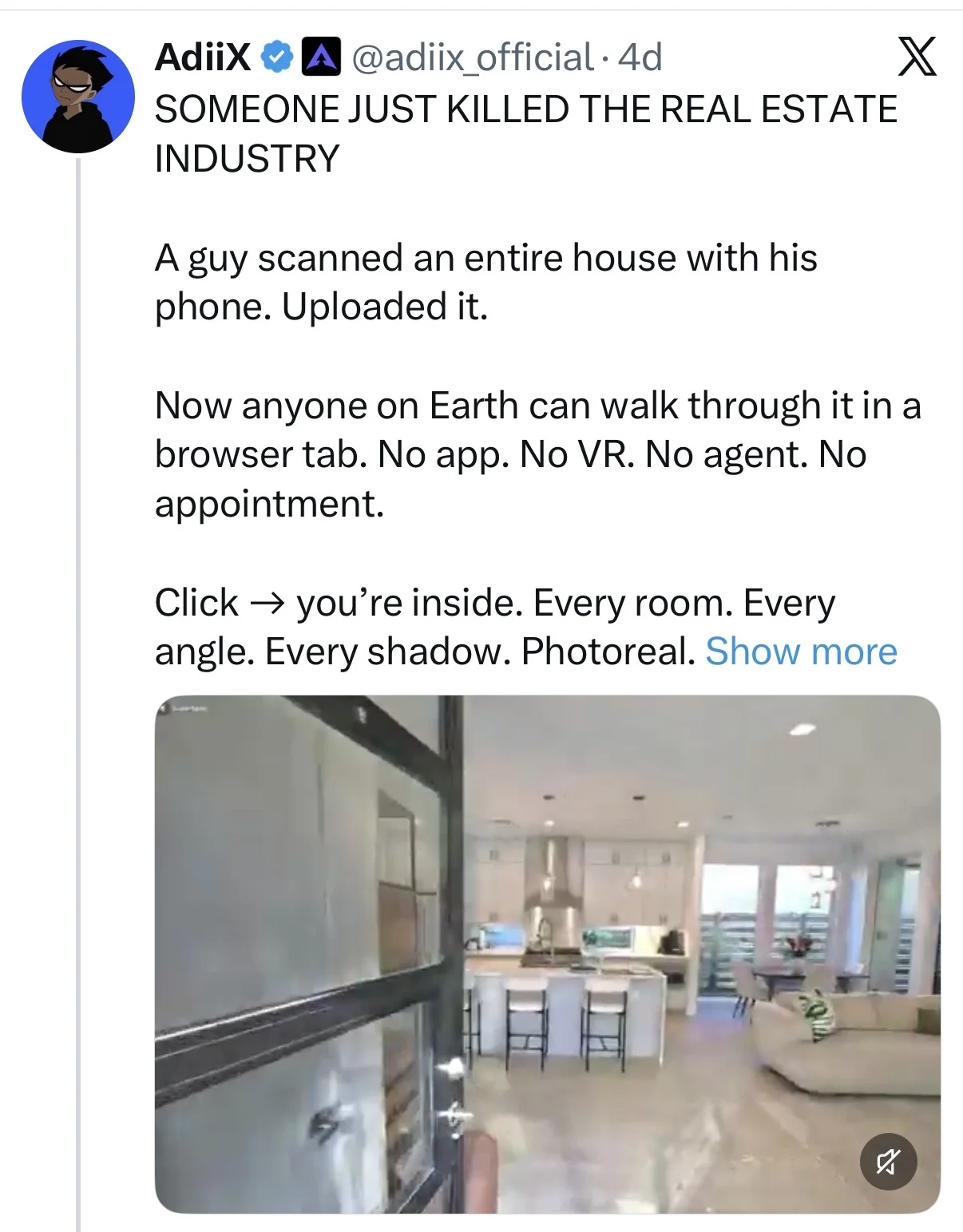
Over the last few weeks, I've seen several viral posts showing "Gaussian splat" real estate walkthroughs.
And honestly, some of them look incredible.
The idea is simple: walk through a property with a camera or phone, AI reconstructs the space, and buyers can move through it in a browser. The walkthroughs feel more immersive and photorealistic than traditional 3D tours.
People are calling it the future of real estate media.
Maybe they're right.
But I also think there's a decent chance this entire category gets leapfrogged by generative video AI within a few years.
At HomeJab, we pay close attention to emerging real estate media technology. We've spent years building nationwide photography, video, editing, scheduling, and delivery infrastructure. We're always evaluating what actually improves the buyer experience and what is simply the latest tech trend.
And that's where I think the conversation around Gaussian splats gets interesting.
What Are Gaussian Splats?
Without getting too technical, Gaussian splats are an AI-driven way to reconstruct a 3D scene from photos or video.
Instead of building a traditional polygon-based 3D model like older virtual tour systems, the AI creates millions of tiny "splats" or points in space that together form a highly realistic environment.
The result can look surprisingly good:
- realistic lighting
- natural depth
- smooth movement through rooms
- browser-based viewing
- no headset required
Compared to older virtual tour technology, it feels like a major leap forward.
That's why the real estate industry is suddenly paying attention.
But Here's the Problem
Real estate buyers don't care about Gaussian splats.
They care about emotional connection.
Most buyers are not evaluating:
- rendering methods
- point clouds
- scene reconstruction
- file formats
- browser rendering pipelines
They want to know:
- Does this home feel warm?
- Can I picture my family here?
- Does the kitchen flow nicely into the living room?
- How does the natural light feel?
- Can I imagine myself walking through this space?
The technology underneath the experience is mostly irrelevant to them.
And that's important because Gaussian splats still have real limitations:
- awkward navigation
- visual artifacts
- strange mirror reflections
- broken geometry around windows
- large file sizes
- inconsistent mobile performance
- complicated capture workflows
Some demos look amazing. Others still feel a little glitchy and experimental.
For higher-end use cases like architecture, museums, digital twins, or commercial spaces, that may be acceptable.
For mainstream residential real estate, buyers usually want something simpler.

The Bigger Shift: Buyers Consume Listings Like Media Now
The way people browse homes has changed dramatically.
Most listing discovery now happens on:
- mobile phones
- TikTok
- YouTube
- Zillow-style scrolling experiences
People consume homes more like content than technical 3D environments.
And that's why I think generative video AI may ultimately become more important than splats for residential real estate.
Why Generative Video Might Leapfrog Splats
AI video models are improving at an incredible pace.
Tools like:
- OpenAI
- Runway
- Luma AI
are rapidly pushing toward AI-generated cinematic video experiences.
That changes the equation.
Because real estate may not actually need true interactive 3D.
It may only need the feeling of walking through a home.
Imagine this workflow:
- A photographer captures standard listing photos and short video clips
- AI reconstructs the layout and camera paths
- The system generates a smooth cinematic walkthrough automatically
- Lighting is enhanced
- Motion is stabilized
- Transitions between rooms become seamless
- Vertical and horizontal versions are instantly created for social platforms
Now compare that experience to a complicated interactive 3D viewer.
For most buyers, the generated walkthrough may actually feel better.
More emotional. More cinematic. More natural. More shareable.
And importantly, easier to consume on mobile devices.
The Technology May Change Faster Than People Think
Five years ago, many people believed traditional virtual tours were the future.
Today, everyone is talking about Gaussian splats.
In another few years, the dominant format could be something completely different.
That's why we believe the real long-term value in real estate media is not necessarily the rendering technology itself.
It's:
- fast capture workflows
- consistent nationwide execution
- AI-enhanced editing
- emotional storytelling
- seamless delivery
- better buyer engagement
The underlying technology will continue evolving.
The buyer experience is what matters.
Our View at HomeJab
At HomeJab, we think immersive media absolutely matters. We're watching Gaussian splats and spatial AI very closely.
But we're even more interested in where generative video is heading.
Because ultimately, buyers are not searching for "the most technically accurate rendering pipeline."
They want to feel something when they view a property.
And in residential real estate, emotional connection will probably matter more than perfect 3D reconstruction.